Greeting & Viewing guide
- 노동역사관
- None
- 2021.4.28
- 0
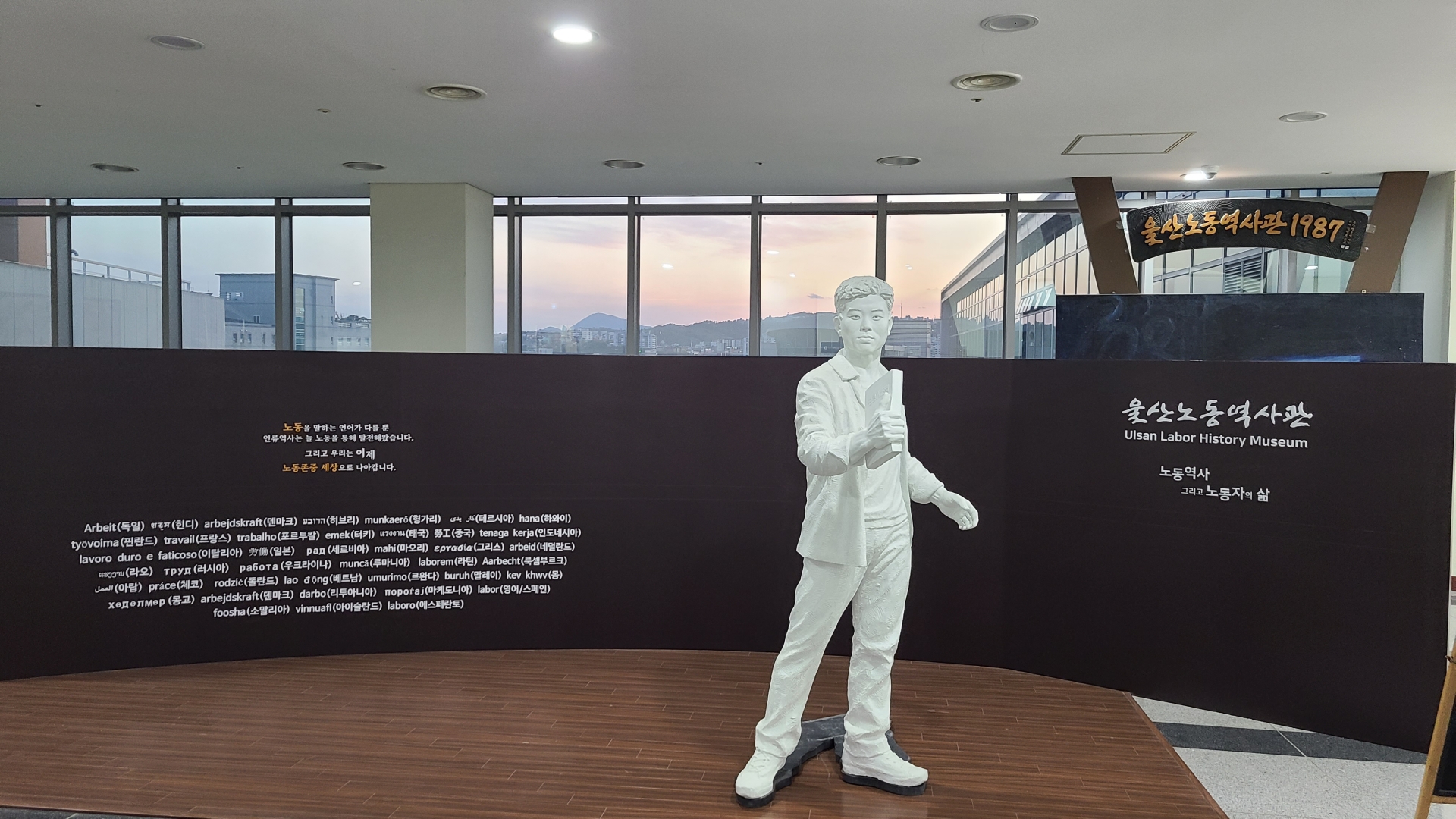
'Labor' is an important part of human'life' that has existed with the advent of mankind, and'worker' is a class that emerged with capitalism and is the broadest and most important member of social development. The Ulsan Labor History Museum is a space to remember the labor history of Ulsan region from prehistoric times to the present, and to preserve and organize historical data. In particular, it is a space that symbolizes the '1987 Great Workers' Struggle' that started in Ulsan and spread across the country.
Ulsan has preserved the petroglyphs of Cheoncheon-ri, Bangudae, where the first labor of mankind, hunting and gathering, was recorded before the prehistoric period. And since BC, iron smelting (Dalcheon iron mill) and salt production (Ulsan Salt) have been developed. Through the modern era, the number of workers increased mainly in the port of Bang-eojin, Dong-gu during the Japanese colonial period, and the labor movement began with it. And, as the'Ulsan Surijohap' (Surijohap; water irrigation infrastructure union) strike showed, peasants became workers, but they had to suffer very poor exploitation. In response, the Ulsan Labor Union gathered workers and actively launched an anti-Japanese (imperialism) movement.
Ulsan's labor history has gone through a twist of history that has faded in the process of massacre and oppression of left-right confrontation after liberation and enters the industrialization period after 1962. As the Ulsan Industrial Center was established as the first national industrial complex, workers entered Ulsan on a large scale. However, workers in large corporations and large factories were concentrated in long hours, low wages, and dangerous labor, and labor rights were at the bottom. Workers complained about themselves as “slave”.
Amidst the struggle of the Hyundai Shipyard in 1974 and the attempt to establish a union in the 1980s, the democratic struggle in June 1987 brought a new frenzy. The great workers' struggle from July to September 1987 began in Ulsan, and a typhoon of democratic unions spread across the country. During this period, democratic unions were established in most of the major business sites in Ulsan, laying the foundation for the current Korean labor movement.
Nearly 35 years after 1987, workers' lives have changed significantly, but there are still dark shadows. They are called by various names such as non-regular workers, specially employed workers, subcontracted workers, and migrant workers, and are often driven to incomplete employment. And in the midst of the pandemic situation and the change of the fourth industry, workers were the first to face a critical situation.
The Ulsan Labor History Museum is the first “labor”-centered museum to be built in the country, and it contains the history of labor and the lives and culture of workers. Instead of staying in the past, we will reflect the changes in Ulsan's labor history and add imagination to the future. It will be a cultural shelter for Ulsan citizens, and a space for youth and youth to experience labor human rights and democratic citizenship education. And the newly opened Ulsan Labor History Museum is a historical space that records an important part of the history of democracy in Korea, and will welcome people from all over the country and around the world.
2021. 5. 1,
131th MAY DAY, Ulsan Labor History Museum
- Open: Tuesday – Saturday, 10:00-19:00
- Close: Sunday – Monday, statutory holiday.
- Group viewing on the closed day will be open through consultation.
- Inquiries: Office of the Labor History Museum (052-283-1987)
Free viewing
: Visiting the Ulsan Labor History Museum exhibition: 30 minutes
Group application
: Ulsan Labor History Explanation: 30 minutes
: Experience Program: 30 Minutes